Earlier this month, our Tech Lead Steve I were invited to a Social Impact Accelerator in Virginia, US. More on that here.
We shared with the other organisations there (all amazing groups doing amazing things) about the difference you and this community of ours make every year.
The conversations went something like this:
“That’s incredible that you reach so many kids, that’s percentage points of all children in your country, right? Wow.
…And what do you guys do for the other 2/3s of the year?”“Well, we work our regular jobs and look after our kids; this is volunteer work”
…”Wait, what? That’s insane. You would be a full team of paid staff here.”
It was interesting because it reminded me of the double-edged sword of mahi tūao (volunteer work) in Aotearoa. On the one hand, we just get the thing done, many of us will volunteer and do whatever it takes, whether or not we have sustainable - or any - funding. This means that kaupapa happen, and our values are brought to life.
On the other hand, it means there are a lot of helpful initiatives that start off well and then die slowly because they become too big to live on aroha alone, and our system isn’t set up to fund them, aaand we’re not very good at going and finding money for this kind of thing when it’s needed.
Our funding landscape is so challenging that as Shoebox Christmas we’ve been moving away from a model that has any reliance on funding. This is really hard but I think it’s the only way for a kaupapa like ours to become resilient and keep existing - I wanted to share a bit about how that’s gone.
I’ve been working on this kaupapa for 12 years now after starting with one school in Porirua in 2014, Google Sheets and texting my mates to help.
Since then we’ve gone through all of these iterations (plus a few false starts):
One centralised drop-off area for a region - all the gifts go there, and we drive them out to where they’re meant to go.
Multiple drop-off spots around a city - we then partner with a courier service to pick them all up and take them to a sorting area before driving them out to where they need to go.
Having an entire airport-based warehouse to sort and coordinate volunteer drivers taking thousands of gifts from the warehouse out to dozens of schools and services (that one meant every single weekend from October to December was working on this… definitely my least favourite).
To the current delivery model of gifts being taken by the gifter, to the place they need to be.
The current model isn’t just about making the kaupapa sustainable and resilient; it also means you, the gifter, getting the opportunity to connect with this school or service kanohi ki te kanohi (face to face). Building stronger community connections is half of what we’re here to do, and you’re half of that relationship.
In terms of project coordination - we’ve tried:
One volunteer looking after it for the country.
Region leads looking after it for their rohe.
Rangatahi volunteers looking after it for their suburb or community.
Relying on funding so we could pay coordinators in different regions.
Relying on funding so we could pay rangatahi in different regions.
Building an NZQA micro-credential on values-based leadership so that rangatahi are paid with education instead (removing reliance on funding, but placing it instead in an education partner).
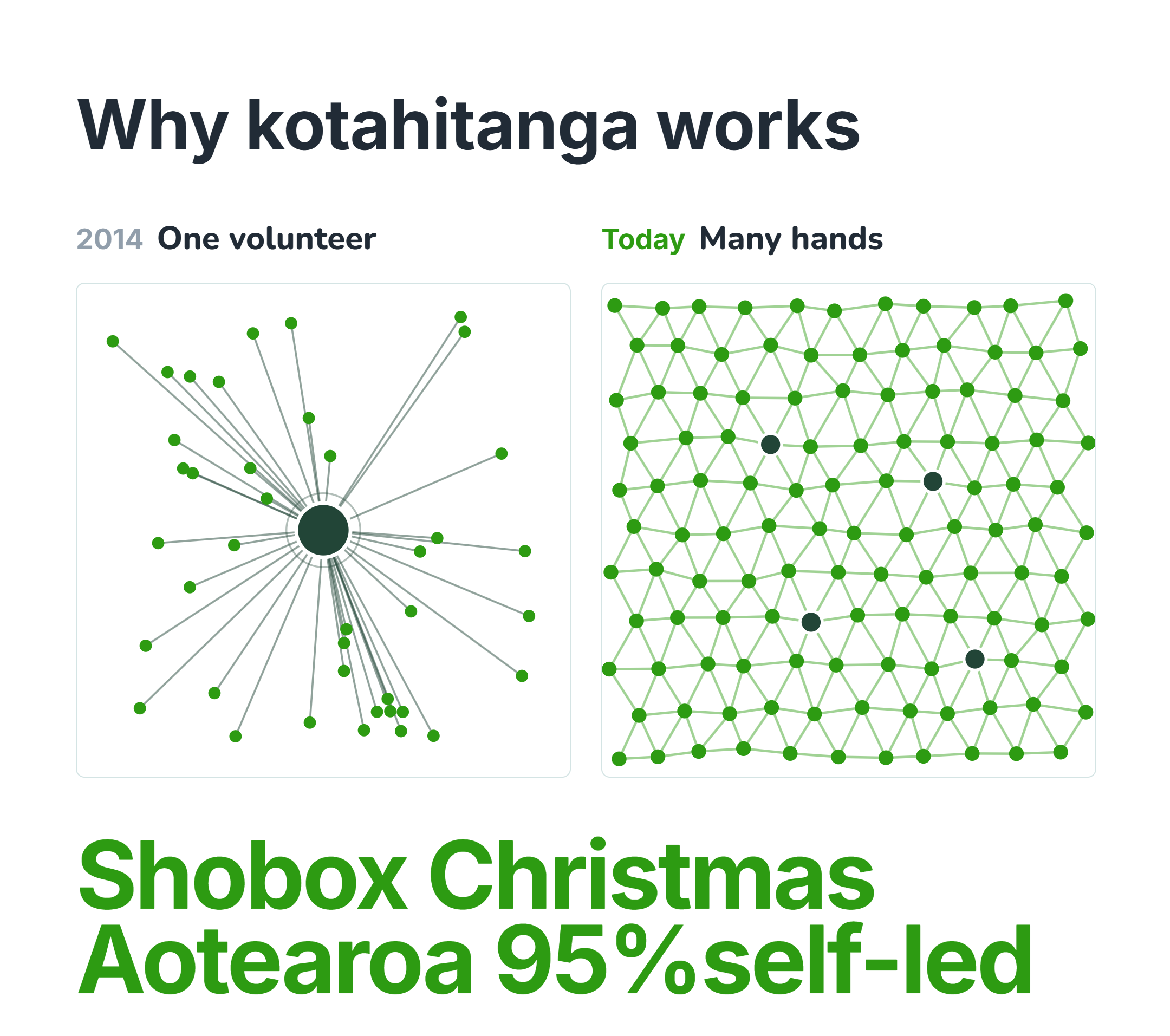
The ultimate challenge that many kaupapa like ours, which deliver great outcomes, face with most of those models is that they’re reliant on funding in some shape or form.
Funding is never guaranteed. And if your outcomes are dependent on the government of the day’s funding priorities, or if there are local grants available (or not), to help, as well as the (significant) time it takes to work through those funding approaches, then your outcomes, even for something that should be community-led and driven, are reliant on someone else.
Importantly, all of these models have needed a centralised group of people or a person who can give time, most days of the week, every week from September to Christmas.
For me personally, I’ve always been happy to do that because I believe our contribution in whatever form we can pay, to being community, is the price we pay for not walking through the world alone.
But more importantly, I’m not going to be here forever, and neither will Arita, Dan, Sam, Lisa, Vyaan, or any of our amazing rangatahi leaders across the motu. So I’ve personally spent about 4 years trying to find better ways to do this.
Early on we tried to have one set of rules, one set of drop-off dates, for the increasingly gigantic kaupapa that has become ‘Shoebox Christmas Aotearoa’ - but that didn’t work because schools and social services all have different office hours, different closing dates for the year. Solving that challenge was really the start of building Koha Tree - to allow us to have these ‘projects or kaupapa’ set up for each school with their own rules and approach.
Decentralising completely means our schools and social services who receive the koha, are actually the ones leading their own projects on Koha Tree. Not me, not a team of centralised volunteers or paid kaimahi (staff).
Last year we had about 15% of our projects being led by the services and schools themselves.
This year, we have about 95% - that means we’re very nearly properly decentralised. This is actually amazing and just writing it makes me excited.
It means we’re that much more resilient. It means if one volunteer leader isn’t able to help out this year because of whānau issues, sickness, overwhelming-life, death, or any of the dozens of things that I’ve somehow avoided the last 12 years, it’s only their one project, and maybe 100-200 tamariki affected, not 17,000.
It also means we have no limit on how or who we can help as a community - because we can open more projects beyond what me, Arita, Dan and Lisa have capacity to help hands-on with - and more importantly, what our own whānau have capacity for us to be absent over the last quarter of the year.
There’s no central ‘leadership’ in a tangi - there’s a collective relationship, tea towels, tables, and many hands.
This is why we built Koha Tree. Not just because the magic is in doing this for your own community, not just because of the learnings our rangatahi in particular pick up along the way - skills that serve them in whatever they go on to do. Those are nice, but mostly it’s out of necessity because movements like this one you’re a part of don’t survive if they rely on just a few of us. Just like the community can’t rely on one speaker or cook to take time off work every time there’s a tangi. Our sharing of aroha through Shoebox Christmas is just a different set of tea towels and benches and every coordinator who puts up their hand is what keeps the movement going.
That’s kotahitanga - woven togetherness and collective action - not uniformity and centralisation.
And Shoebox Christmas Aotearoa and Koha Tree, exist for aroha and kotahitanga. So making the model itself based on it feels a whole lot better too.
I’m really proud of our schools and services for picking this up and leading so many amazing initiatives across the motu.
Ngā manaakitanga,
Pera